Armsol Is Helping Engineering Colleges and ITI Labs Across India Go Industry-Ready
PR & News

How to Choose the Right Soldering Equipment for Electronics Work in India — A Complete Guide

How to Choose the Right Soldering Equipment for Electronics Work in India — A Complete Guide

Whether you’re a hobbyist building your first circuit or a manufacturer running a production line, here’s what to look for — and why it matters

Why Your Soldering Equipment Matters More Than You Think

Soldering is the invisible backbone of all electronics. From a student’s first Arduino circuit to a factory assembling thousands of PCBs a day, the quality of the solder joint determines whether a device works reliably or fails prematurely. And yet, choosing the right soldering equipment — the right iron, the right wattage, the right station — is a decision that most beginners and even some professionals make without enough information.

This guide breaks it down simply: what to look for, what the differences are, and how to match your equipment to your actual needs.

Understanding Wattage — The Most Common Source of Confusion

Wattage is the single most important specification on a soldering iron, and it is widely misunderstood. More watts does not mean more heat — it means more capacity to maintain heat when working on demanding joints. Here is a practical breakdown:

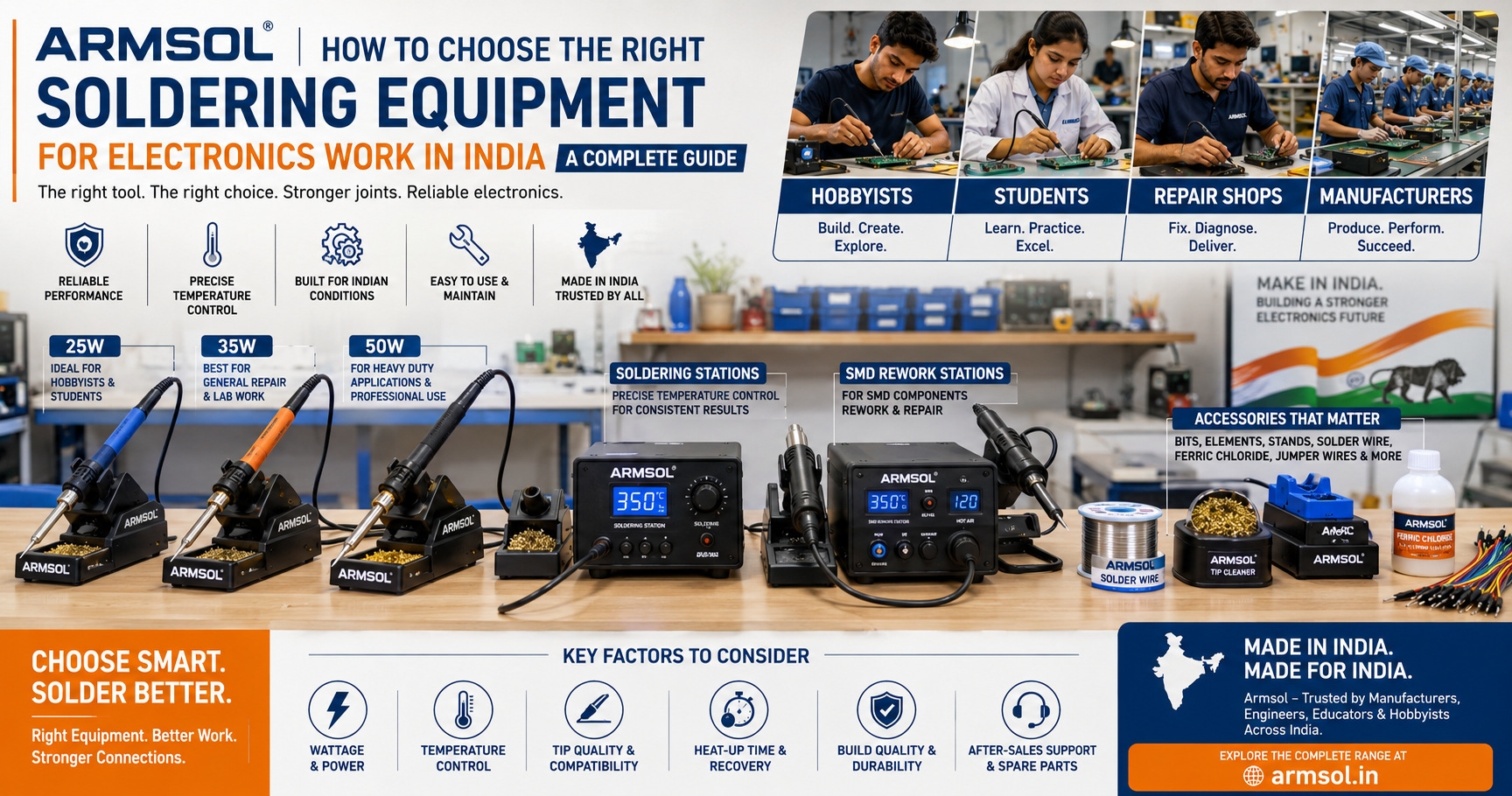
25W Soldering Irons are ideal for beginners, hobbyists, and students working on standard PCB components, light Arduino projects, or basic electronics repair. They are compact, affordable, and easy to control. Armsol’s 25W irons come with both spade and pointed tip options to suit different joint types.

35W Soldering Irons offer a step up in power, making them suitable for general electronics repair, component replacement, and lab work. They recover heat faster after contact with a joint, reducing the risk of cold solder. This is the most versatile wattage for regular electronics work.

50W Soldering Irons are built for heavy-duty applications — thick wire connections, large solder pads, grounding joints, and production environments where speed and heat recovery are critical. The Armsol 50W range is designed for sustained use in professional and manufacturing settings.

Soldering Iron vs Soldering Station — What’s the Difference?

A standalone soldering iron is a simple tool: plug in, heat up, solder. It is portable, affordable, and perfectly adequate for most hobby and repair work. A soldering station, on the other hand, consists of a temperature-controlled unit with a handpiece. You can set and maintain an exact temperature, which is essential for working with sensitive SMD components, lead-free solder, or high-volume production where consistency is non-negotiable.

For hobbyists and students: a quality 25W or 35W iron is usually the right starting point. For repair shops and professionals: a temperature-controlled soldering station is worth the investment. For electronics manufacturers: both irons and stations will likely feature in your workflow at different stages.

SMD Rework Stations — For the Advanced User

Surface-mount device (SMD) components have become the standard in modern electronics. They are smaller, faster to assemble, and more efficient — but they are also more challenging to rework or replace manually. SMD rework stations combine hot air and soldering capabilities to allow precise component removal and replacement without damaging the board or surrounding components.

For electronics manufacturers handling PCB rework, repair shops servicing modern devices, and advanced hobbyists working on miniaturised projects, an SMD rework station is an essential part of the toolkit. Armsol’s rework station range is built for consistent hot-air performance in Indian working conditions.

Quality Markers to Look For

When buying soldering equipment — whether it is your first iron or your tenth station — here is what separates reliable tools from unreliable ones: consistent temperature delivery (not just rated wattage), heating element lifespan and replaceability, tip/bit material and compatibility with spares, heat-up time, and the availability of after-sales support and spare parts locally.

This last point is particularly important in India. Imported brands may offer quality products, but spare tips, elements, and accessories can take weeks to arrive and cost significantly more. Choosing a domestic manufacturer like Armsol means spare parts are available quickly, affordably, and without import dependency.

Don’t Overlook the Accessories

A complete soldering setup goes beyond the iron. A sturdy soldering iron stand prevents burns and keeps your workspace safe. A quality sponge or brass tip cleaner maintains tip performance over time. For PCB fabrication hobbyists, Ferric Chloride for PCB etching and jumper wires for circuit connections round out the toolkit. Armsol supplies all of these — making it a single-source solution for electronics professionals and enthusiasts alike.

Why Buying Indian-Made Makes Sense in 2026

With Make in India gaining real momentum and the electronics manufacturing ecosystem expanding rapidly, domestic soldering equipment manufacturers have risen to meet industrial-grade standards. Armsol, based in Mumbai, is a prime example: a full product range covering irons, stations, SMD rework equipment, bits, elements, stands, and accessories — manufactured in India, available pan-India, and backed by a manufacturer that understands local working conditions.

Whether you are a first-time hobbyist building your first circuit board, an ITI student learning electronics fundamentals, a repair technician servicing consumer devices, or a production engineer managing a high-volume PCB line — there is an Armsol product designed for your needs.

Explore the complete Armsol product range at armsol.in. Trusted by manufacturers, engineers, educators, and hobbyists across India.

MEDIA CONTACT

  • Armsol — Soldering Equipment Manufacturer
  • Address:  Lamington Rd, Opp. Police Station, Girgaon, Mumbai, Maharashtra 400007
  • Email:     info@armsol.in
  • Phone:    022-3863549  |  022-23854510
  • Website:  https://armsol.in
Armsol Is Helping Engineering Colleges and ITI Labs Across India Go Industry-Ready
PR & News

Armsol Is Helping Engineering Colleges and ITI Labs Across India Go Industry-Ready

Armsol Is Helping Engineering Colleges and ITI Labs Across India Go Industry-Ready

As India pushes for skilled workforce development, Mumbai’s Armsol bridges the gap between classroom learning and real-world electronics manufacturing

Building Skilled India, One Solder Joint at a Time

India is on a mission. With the National Education Policy (NEP) emphasising hands-on, skill-based learning and the government’s aggressive expansion of ITI and polytechnic institutes, the country is investing heavily in building a technically capable workforce for the 21st century. Electronics — from circuit assembly to PCB design — sits at the heart of this skill agenda.

But there is a challenge that many academic institutions are quietly grappling with: the quality of lab equipment available to students doesn’t always match the standards they will encounter in the real world.

The Lab Equipment Gap

Walk into many engineering college or ITI electronics labs across India, and you will find soldering irons that overheat unpredictably, heating elements that burn out within months, and tools that bear no resemblance to what students will encounter on an actual production floor. The result is a skills gap that goes beyond knowledge — students graduate without true hands-on familiarity with industry-grade equipment.

This gap has real consequences: longer onboarding periods for fresh hires, higher rework rates in entry-level roles, and a persistent disconnect between academic training and industrial expectation. The solution doesn’t require a massive budget. It requires access to the right equipment.

Armsol: Closing the Gap

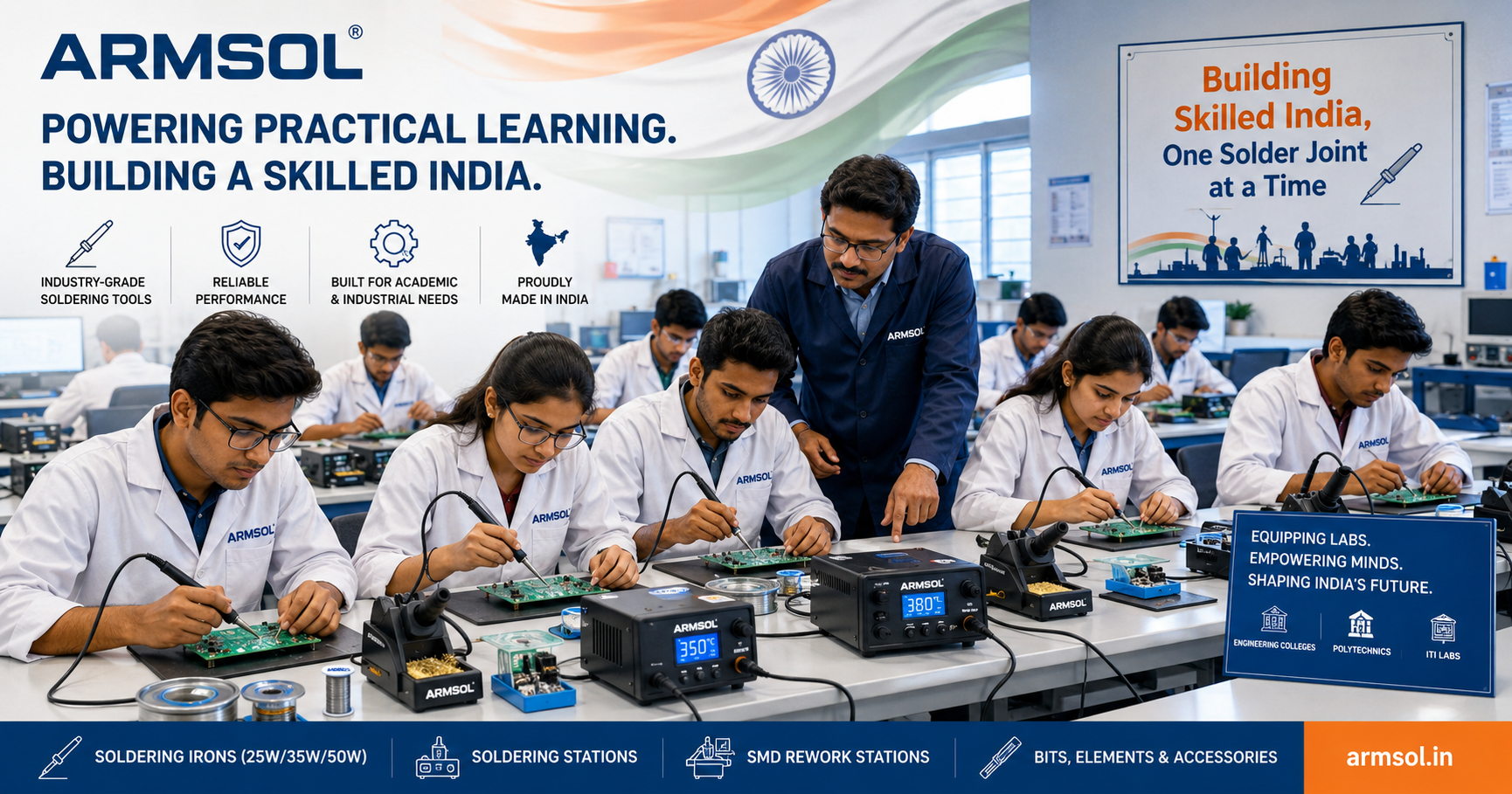
Mumbai-based Armsol has emerged as a trusted name for academic institutions looking to equip their labs with professional-grade soldering tools without straining their procurement budgets. Armsol’s product range — spanning soldering irons (25W, 35W, and 50W), soldering stations, SMD rework stations, heating elements, soldering bits, stands, and PCB accessories — is designed to serve both industrial and academic environments with equal reliability.

The breadth of the range is particularly important for educational institutions. A 25W soldering iron is ideal for introductory electronics courses; 35W suits general lab work and component assembly practice; 50W handles heavier-duty applications taught in advanced modules. One supplier, one ecosystem, all academic needs covered.

Why It Matters for Students

When students train on Armsol equipment, they are not just learning to solder — they are building familiarity with the category of tools used in real-world electronics manufacturing. This hands-on exposure to consistent, industry-aligned equipment directly improves their employability, their confidence, and the quality of their practical output.

For lab coordinators and heads of department, the benefits extend further: reduced equipment downtime, easier spare parts sourcing across India, and the institutional confidence that comes from associating with an established domestic manufacturer.

Trusted by India, Made in Mumbai

Armsol’s growing footprint across academic institutions reflects a broader recognition that quality soldering equipment need not be imported or unaffordable. As a Mumbai-based manufacturer with pan-India availability, Armsol understands the procurement realities of Indian educational institutions — and has built its product line accordingly.

In a country that is training millions of electronics technicians, engineers, and lab technologists every year, the tools they learn on matter. Armsol is committed to ensuring that those tools are reliable, industry-aligned, and proudly Indian.

Academic institutions, lab coordinators, and procurement committees are welcome to explore Armsol’s complete product range at armsol.in or get in touch for bulk and institutional supply inquiries.

MEDIA CONTACT

  • Armsol — Soldering Equipment Manufacturer
  • Address:  Lamington Rd, Opp. Police Station, Girgaon, Mumbai, Maharashtra 400007
  • Email:     info@armsol.in
  • Phone:    022-3863549  |  022-23854510
  • Website:  https://armsol.in
Why Indian EMS Companies Are Choosing Armsol for Production-Line Soldering
PR & News

Why Indian EMS Companies Are Choosing Armsol for Production-Line Soldering

Why Indian EMS Companies Are Choosing Armsol for Production-Line Soldering

Mumbai-based Armsol is redefining soldering standards for India’s fast-growing electronics manufacturing sector

India’s Electronics Manufacturing Moment

India is in the midst of a historic electronics manufacturing revolution. Driven by the Production Linked Incentive (PLI) scheme and the government’s ambitious Make in India push, the country’s Electronics Manufacturing Services (EMS) sector is expanding at an unprecedented pace. From consumer electronics to defence components, PCB assemblies to automotive electronics — Indian factories are scaling up, and scaling fast.

In this high-growth environment, every component of the production process matters. And yet, one critical factor is consistently overlooked: the quality of soldering equipment on the production line.

The Problem with the Status Quo

Most Indian EMS companies face a difficult choice when it comes to soldering tools. Imported equipment from European or Japanese brands is reliable — but expensive, with long lead times, high maintenance costs, and limited after-sales support in India. On the other hand, low-cost local alternatives often deliver inconsistent temperature performance, short element lifespan, and high replacement frequency — all of which directly impact product quality, rework rates, and ultimately, margins.

Neither option serves the needs of a growing Indian EMS company trying to compete on quality while controlling costs. There has long been a gap in the market for a domestic manufacturer that combines industrial-grade reliability with Indian pricing and support.

Armsol: Built for Indian Production Lines

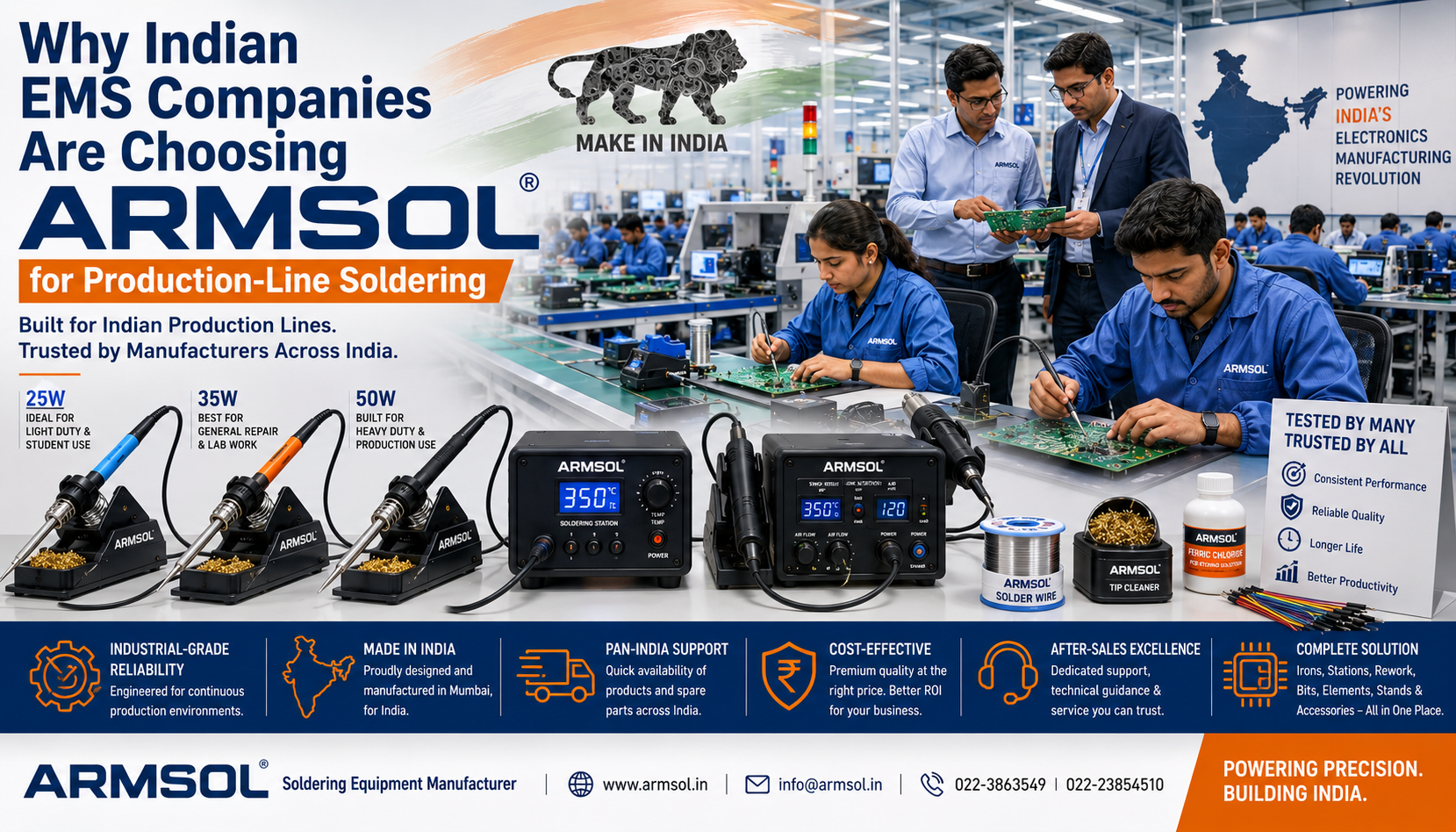
That gap is precisely what Armsol was built to fill. Founded and headquartered in Mumbai, Armsol is a dedicated soldering equipment manufacturer offering a comprehensive product ecosystem — soldering irons (25W, 35W, and 50W), soldering stations, SMD rework stations, soldering bits, heating elements, stands, and accessories including PCB etching solutions and jumper wires.

Every Armsol product is engineered with production environments in mind: consistent temperature delivery, durable heating elements, ergonomic design for extended use, and readily available spare parts across India. The brand’s tagline says it best — Tested by Many, Trusted by All.

Why EMS Companies Are Making the Switch

For electronics manufacturers running high-volume production lines, the advantages of Armsol go beyond just price. Local manufacturing means faster spare parts availability and no dependency on international supply chains. Consistent product quality across batches ensures that production standards remain uniform. And with a product range that spans basic soldering irons to advanced SMD rework stations, Armsol can serve the full spectrum of soldering needs within a single facility — from through-hole assembly to surface-mount rework.

Armsol’s growing presence across manufacturing hubs in India reflects the trust that EMS companies, electronics assembly units, and component manufacturers are placing in a brand that understands their environment.

A Long-Term Supply Partner, Not Just a Vendor

What sets Armsol apart in an increasingly competitive market is its commitment to being a supply partner rather than a one-time vendor. With pan-India availability, a complete product catalog, and a manufacturer’s understanding of industrial requirements, Armsol is positioned to grow alongside its clients — whether they are a 10-person PCB assembly unit today or a 500-person EMS facility tomorrow.

For EMS companies and electronics manufacturers ready to upgrade their production-line soldering capabilities without compromising on budget or reliability, Armsol offers a compelling, made-in-India alternative. Explore the full product range at armsol.in or reach out for bulk inquiry and supply tie-ups.

MEDIA CONTACT

  • Armsol — Soldering Equipment Manufacturer
  • Address:  Lamington Rd, Opp. Police Station, Girgaon, Mumbai, Maharashtra 400007
  • Email:     info@armsol.in
  • Phone:    022-3863549  |  022-23854510
  • Website:  https://armsol.in
Soldering & De-soldering liquid flux
Uncategorized

Soldering Flux: The Unsung Hero of Soldering

Soldering Flux: The Unsung Hero of Soldering

Buy Here: Armsol Soldering Flux

When we think about soldering, the first things that often come to mind are the soldering iron, the solder wire, and the components being joined together. While these elements are undeniably crucial to the soldering process, there’s one unsung hero that plays a vital role in ensuring a successful solder joint: soldering flux. Often overlooked or taken for granted, soldering flux is a key component that can make all the difference in achieving a strong and reliable solder connection.

Understanding the Role of Soldering Flux:

Soldering flux is a chemical compound used in the process of soldering to facilitate the formation of a strong and stable bond between two metal surfaces. It serves multiple important functions during soldering:

  1. Oxidation Prevention: One of the primary functions of flux is to prevent oxidation on the surfaces of the metals being soldered. When metals, especially those like copper and brass, are exposed to air, they rapidly develop oxide layers that can hinder the solder’s ability to bond with the base material. Flux creates a protective barrier that shields the metal from the surrounding air, ensuring a clean and oxide-free surface for soldering.
  2. Surface Wetting: Flux acts as a surfactant, promoting wetting by reducing the surface tension of the solder. This property allows the solder to spread evenly and smoothly over the joint, creating a strong bond with the metal. Without flux, the solder may form beads or refuse to flow, resulting in weak and unreliable connections.
  3. Decontamination and Cleaning: Flux helps to clean the surfaces to be soldered by removing any contaminants like dirt, grease, or residues from previous soldering jobs. Clean surfaces are essential for the proper adhesion of the solder, and flux ensures that any impurities are eliminated.
  4. Heat Transfer Enhancement: Soldering flux also aids in heat transfer during the soldering process. By promoting efficient heat conduction, flux helps the solder melt at the right temperature and ensures that it flows smoothly into the joint. This property is particularly useful when soldering large or heat-sensitive components.

Types of Soldering Flux:

Various types of soldering flux are available, each suited for specific applications and materials:

  1. Rosin Flux: This is one of the most common types of flux and is often used in electronics soldering. It is derived from the sap of pine trees and comes in different grades, such as RMA (Rosin Mildly Activated) and RA (Rosin Activated). Rosin flux is known for its excellent cleaning properties and is best suited for soldering electronics and delicate components.
  2. Water-Soluble Flux: As the name suggests, this flux is water-soluble, making post-soldering cleaning easier. It is often used in applications where residue removal is crucial, such as in the assembly of PCBs.
  3. No-Clean Flux: No-clean flux is designed to leave minimal to no residue after soldering. It is suitable for applications where thorough cleaning may be difficult or impractical.
  4. Paste Flux: This type of flux comes in a paste or gel-like form and is particularly useful for selective or precise soldering applications, such as surface-mount device (SMD) soldering.

Best Practices for Using Soldering Flux:

To ensure successful soldering, it is essential to follow some best practices when using soldering flux:

  1. Appropriate Amount: Apply the right amount of flux to the joint. Using too little may result in incomplete wetting, while using too much could cause excessive residue buildup.
  2. Even Distribution: Ensure the flux is evenly spread over the soldering area to ensure uniform wetting and bonding.
  3. Proper Ventilation: Some types of flux may release fumes during soldering. Work in a well-ventilated area or use fume extraction to avoid inhalation of potentially harmful substances.
  4. Storage: Store soldering flux properly to prevent contamination and degradation. Keep it in a cool and dry place, away from direct sunlight.

In Conclusion:

Armsol provides soldering flux that is a critical component in achieving strong, reliable, and long-lasting solder joints. Its ability to prevent oxidation, promote wetting, clean surfaces, and enhance heat transfer is invaluable to the soldering process. By using the appropriate type of Armsol flux and following best practices, manufacturers can harness the full potential of this unsung hero and elevate the quality of soldering projects to new heights. So, the next time manufacturers pick up their soldering iron, they should remember to give credit to the unassuming Armsol soldering flux that silently works behind the scenes to make connections secure and projects successful.

Armsol banner
Uncategorized

“Mastering the Art of Soldering: Expert Tips and Techniques” by ARMSOL

Table of Contents

Sr#Headings
1Introduction
2What is Soldering?
3Choosing the Right Soldering Equipment
4Preparing Your Workstation
5Understanding Different Solder Types
6Mastering the Soldering Iron
7Proper Soldering Techniques
8Handling Common Soldering Issues
9Tips for Circuit Board Soldering
10Soldering Safety Measures
11Maintaining Your Soldering Tools
12Advanced Soldering Techniques
13Soldering vs. Welding: What’s the Difference?
14Frequently Asked Questions (FAQs)
15Conclusion

1. Introduction

ARMSOL Invites you to the world of soldering! Whether you’re an electronics manufacturer or a DIY hobbyist, mastering the art of soldering is crucial for assembling and repairing electronic circuits. This comprehensive guide will provide you with expert tips and techniques to elevate your soldering skills to the next level. From understanding different solder types to advanced techniques, we’ve got you covered.

2. What is Soldering?

In simple terms, soldering is a technique used to join two or more metal components together using a filler metal, known as solder. The solder, typically made of tin and lead, melts at a lower temperature and creates a strong, conductive bond between the metals. Soldering is commonly used in electronics to connect components on circuit boards and is an essential skill for electronics manufacturers and hobbyists alike.

3. Choosing the Right Soldering Equipment

To become a soldering master, start by selecting the right equipment. Here’s what you need:

  • Soldering Iron: Invest in a quality soldering iron with adjustable temperature settings for precision soldering.
  • Solder: Choose the appropriate solder type based on your project needs (lead-based or lead-free).
  • Flux: Flux facilitates solder flow and improves the soldering process.
  • Soldering Stand: Use a stand to hold the soldering iron when not in use, preventing accidents.
  • Cleaning Materials: Keep sponges and cleaning pads nearby to maintain a clean soldering tip.

4. Preparing Your Workstation

An organized and clean workstation sets the stage for successful soldering. Follow these steps:

  • Ventilation: Ensure your workspace is well-ventilated to avoid inhaling harmful fumes.
  • Lighting: Proper lighting enhances visibility and accuracy during soldering.
  • Stability: Use a stable work surface to prevent accidental spills or mishaps.
  • Organization: Keep your tools and materials organized for easy access.

5. Understanding Different Solder Types

Different solder alloys suit various applications. The most common types include:

  • Lead-Tin Solder: Offers good conductivity and ease of use but contains lead (not recommended for drinking water applications).
  • Lead-Free Solder: Environmentally friendly, but requires higher temperatures and may be more challenging to work with.

6. Mastering the Soldering Iron

The soldering iron is your primary tool. Here’s how to wield it skillfully: Check Soldering irons By armsol

  • Temperature Control: Adjust the temperature based on the solder and components being used.
  • Tinning the Tip: Regularly tin the soldering iron tip to maintain its effectiveness.
  • Avoid Prolonged Heat: Minimize exposing components to excessive heat to prevent damage.
  • Cooling Down: Allow the soldered joint to cool naturally for a robust connection.

7. Proper Soldering Techniques

Developing proper soldering techniques is essential for reliable connections:

  • Clean Surfaces: Ensure the surfaces to be soldered are clean and free from dirt or oxidation.
  • Heat Distribution: Apply heat evenly to both the pad and component lead for a smooth joint.
  • Right Amount of Solder: Use just enough solder to form a secure connection without excess buildup.
  • Avoid Movement: Hold the soldering iron steady during the soldering process to avoid cold joints.

8. Handling Common Soldering Issues

Soldering can be challenging, but knowing how to address common issues is crucial:

  • Cold Joints: Insufficient heat or movement during soldering can result in weak, cold joints.
  • Solder Bridges: Excess solder between adjacent connections can cause short circuits.
  • Component Damage: Excessive heat or prolonged exposure can damage sensitive components.

9. Tips for Circuit Board Soldering

Working on circuit boards requires extra care and precision:

  • Use the Right Tip: Choose a fine tip for intricate work on small circuit boards.- Check Soldeing Tips By Armsol
  • Work in Sections: Solder one section at a time to avoid excessive heat spreading.
  • Desoldering: Employ desoldering techniques to correct mistakes or replace components. Desoldeing pump by Armsol

10. Soldering Safety Measures

Safety should always be a priority when soldering:

  • Eye Protection: Wear safety goggles to shield your eyes from debris and solder splashes.
  • Heat Protection: Use heat-resistant gloves to protect your hands from burns.
  • Fire Safety: Keep a fire extinguisher nearby in case of emergencies.

11. Maintaining Your Soldering Tools

Proper maintenance ensures the longevity and optimal performance of your soldering tools:

  • Cleaning: Regularly clean soldering tips to prevent oxidation and ensure better heat transfer.
  • Storage: Store soldering equipment in a dry and dust-free environment.
  • Replacement: Replace worn-out or damaged tips and parts promptly.

12. Advanced Soldering Techniques

Once you’ve mastered the basics, explore these advanced techniques:

  • Surface Mount Soldering: Solder tiny surface mount components with precision.
  • Through-Hole Soldering: Master soldering larger components with through-hole connections.
  • Cable Soldering: Learn how to solder and repair wires and cables effectively.

13. Soldering vs. Welding: What’s the Difference?

Understand the distinction between soldering and welding:

  • Soldering: Joins metal components using a lower-melting-point filler material (solder).
  • Welding: Joins metal components by melting their edges and fusing them together.

14. Frequently Asked Questions (FAQs)

Q1: What soldering iron temperature should I use for electronics? A: Generally, temperatures between 350°C to 400°C (660°F to 750°F) work well for most electronics soldering tasks.

Q2: Is lead-free solder better for the environment? A: Yes, lead-free solder is environmentally friendly and complies with regulations, making it a safer choice.

Q3: How do I prevent solder bridges? A: To prevent solder bridges, use a flux pen and ensure the right amount of solder is applied.

Q4: Can I reuse solder? A: Reusing solder is not recommended as it may contain impurities from previous use, affecting soldering quality.

Q5: Why is my soldering iron not melting the solder? A: This could be due to a low-temperature setting or a worn-out soldering iron tip; check and adjust accordingly.

15. Conclusion

Congratulations! You’ve now unlocked the secrets of mastering the art of soldering. Armed with the right knowledge, equipment, and techniques, you can confidently tackle various soldering projects. Remember to prioritize safety, maintain your tools, and continuously practice to refine your skills. Happy soldering!

Visit us to check our range or Soldering products – Armsol.in