How to Choose the Right Soldering Equipment for Electronics Work in India — A Complete Guide

How to Choose the Right Soldering Equipment for Electronics Work in India — A Complete Guide
Whether you’re a hobbyist building your first circuit or a manufacturer running a production line, here’s what to look for — and why it matters
Why Your Soldering Equipment Matters More Than You Think
Soldering is the invisible backbone of all electronics. From a student’s first Arduino circuit to a factory assembling thousands of PCBs a day, the quality of the solder joint determines whether a device works reliably or fails prematurely. And yet, choosing the right soldering equipment — the right iron, the right wattage, the right station — is a decision that most beginners and even some professionals make without enough information.
This guide breaks it down simply: what to look for, what the differences are, and how to match your equipment to your actual needs.
Understanding Wattage — The Most Common Source of Confusion
Wattage is the single most important specification on a soldering iron, and it is widely misunderstood. More watts does not mean more heat — it means more capacity to maintain heat when working on demanding joints. Here is a practical breakdown:
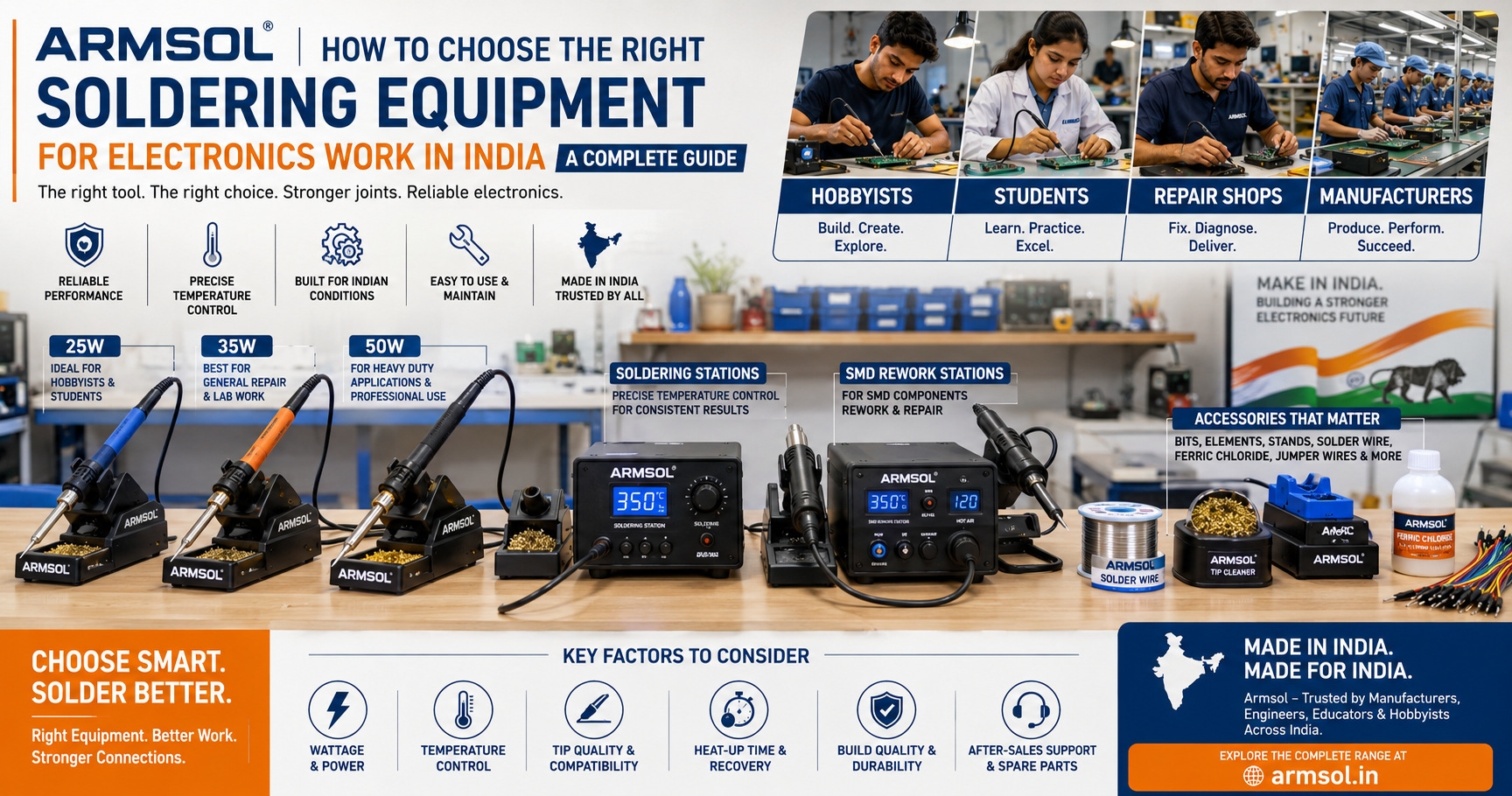
25W Soldering Irons are ideal for beginners, hobbyists, and students working on standard PCB components, light Arduino projects, or basic electronics repair. They are compact, affordable, and easy to control. Armsol’s 25W irons come with both spade and pointed tip options to suit different joint types.
35W Soldering Irons offer a step up in power, making them suitable for general electronics repair, component replacement, and lab work. They recover heat faster after contact with a joint, reducing the risk of cold solder. This is the most versatile wattage for regular electronics work.
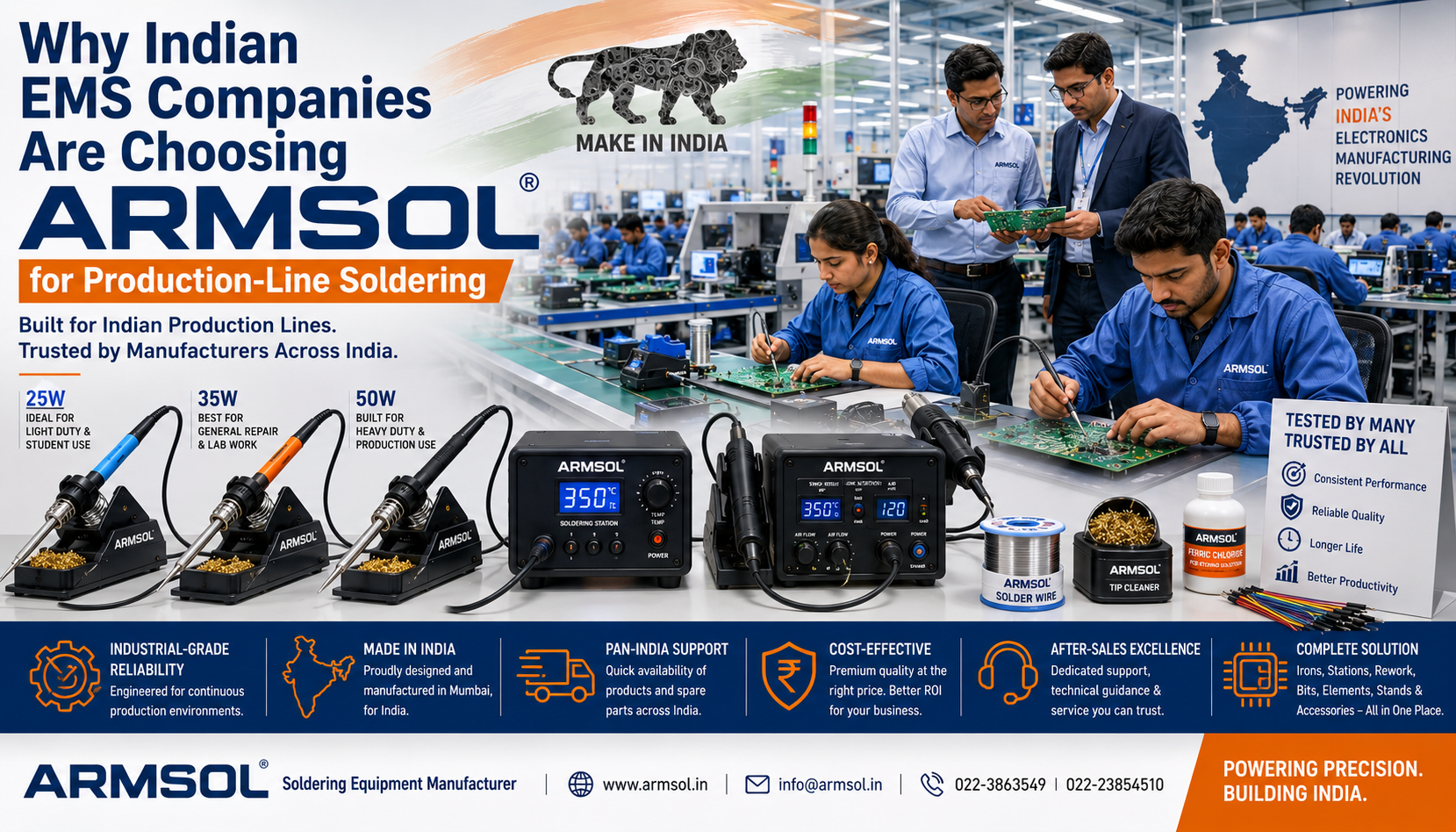
50W Soldering Irons are built for heavy-duty applications — thick wire connections, large solder pads, grounding joints, and production environments where speed and heat recovery are critical. The Armsol 50W range is designed for sustained use in professional and manufacturing settings.
Soldering Iron vs Soldering Station — What’s the Difference?
A standalone soldering iron is a simple tool: plug in, heat up, solder. It is portable, affordable, and perfectly adequate for most hobby and repair work. A soldering station, on the other hand, consists of a temperature-controlled unit with a handpiece. You can set and maintain an exact temperature, which is essential for working with sensitive SMD components, lead-free solder, or high-volume production where consistency is non-negotiable.
For hobbyists and students: a quality 25W or 35W iron is usually the right starting point. For repair shops and professionals: a temperature-controlled soldering station is worth the investment. For electronics manufacturers: both irons and stations will likely feature in your workflow at different stages.
SMD Rework Stations — For the Advanced User
Surface-mount device (SMD) components have become the standard in modern electronics. They are smaller, faster to assemble, and more efficient — but they are also more challenging to rework or replace manually. SMD rework stations combine hot air and soldering capabilities to allow precise component removal and replacement without damaging the board or surrounding components.
For electronics manufacturers handling PCB rework, repair shops servicing modern devices, and advanced hobbyists working on miniaturised projects, an SMD rework station is an essential part of the toolkit. Armsol’s rework station range is built for consistent hot-air performance in Indian working conditions.
Quality Markers to Look For
When buying soldering equipment — whether it is your first iron or your tenth station — here is what separates reliable tools from unreliable ones: consistent temperature delivery (not just rated wattage), heating element lifespan and replaceability, tip/bit material and compatibility with spares, heat-up time, and the availability of after-sales support and spare parts locally.
This last point is particularly important in India. Imported brands may offer quality products, but spare tips, elements, and accessories can take weeks to arrive and cost significantly more. Choosing a domestic manufacturer like Armsol means spare parts are available quickly, affordably, and without import dependency.
Don’t Overlook the Accessories
A complete soldering setup goes beyond the iron. A sturdy soldering iron stand prevents burns and keeps your workspace safe. A quality sponge or brass tip cleaner maintains tip performance over time. For PCB fabrication hobbyists, Ferric Chloride for PCB etching and jumper wires for circuit connections round out the toolkit. Armsol supplies all of these — making it a single-source solution for electronics professionals and enthusiasts alike.
Why Buying Indian-Made Makes Sense in 2026
With Make in India gaining real momentum and the electronics manufacturing ecosystem expanding rapidly, domestic soldering equipment manufacturers have risen to meet industrial-grade standards. Armsol, based in Mumbai, is a prime example: a full product range covering irons, stations, SMD rework equipment, bits, elements, stands, and accessories — manufactured in India, available pan-India, and backed by a manufacturer that understands local working conditions.
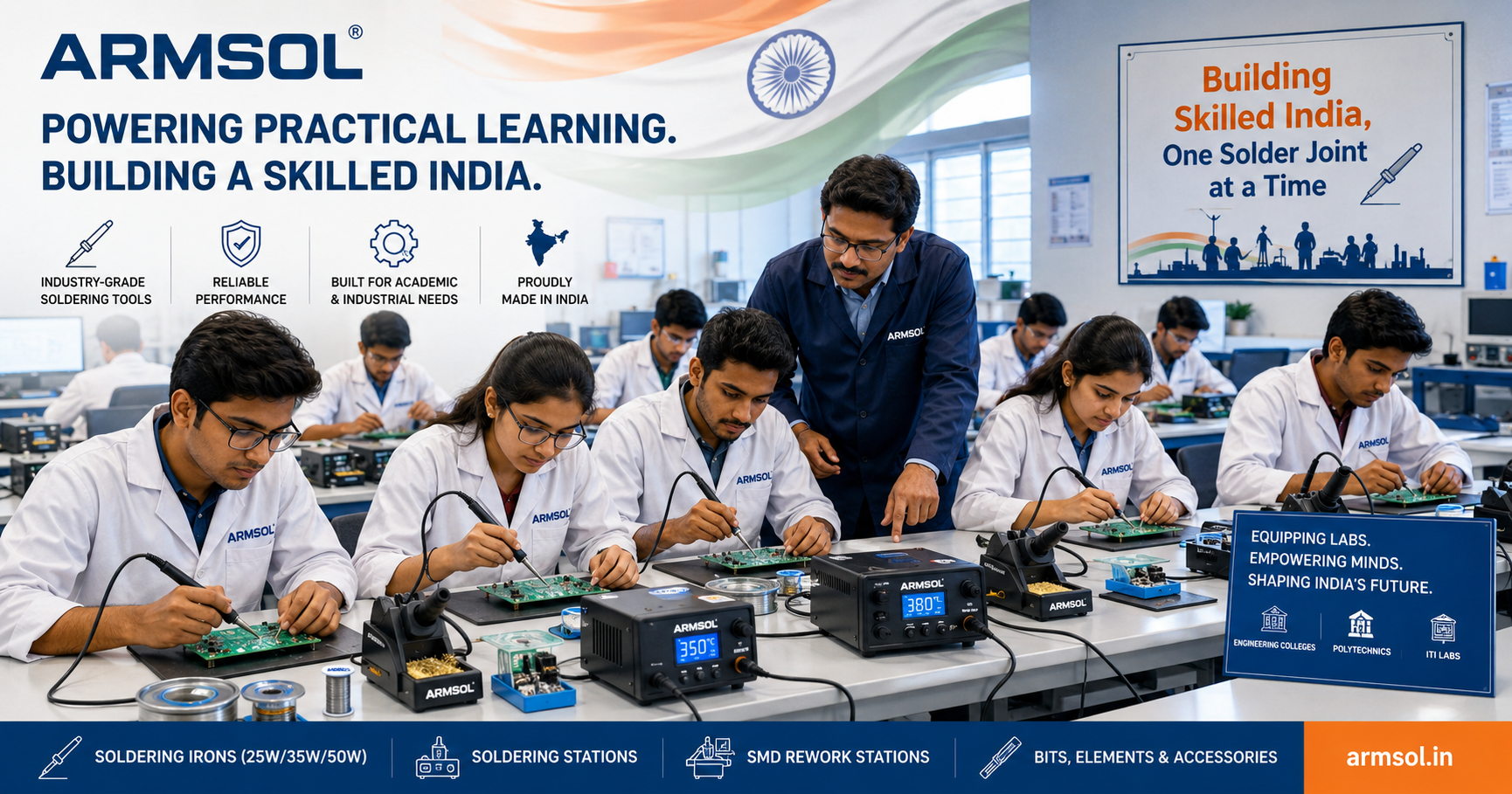
Whether you are a first-time hobbyist building your first circuit board, an ITI student learning electronics fundamentals, a repair technician servicing consumer devices, or a production engineer managing a high-volume PCB line — there is an Armsol product designed for your needs.
Explore the complete Armsol product range at armsol.in. Trusted by manufacturers, engineers, educators, and hobbyists across India.
MEDIA CONTACT
- Armsol — Soldering Equipment Manufacturer
- Address: Lamington Rd, Opp. Police Station, Girgaon, Mumbai, Maharashtra 400007
- Email: info@armsol.in
- Phone: 022-3863549 | 022-23854510
- Website: https://armsol.in